Community Engagement

At Emory & Henry, we believe in civic virtue; Our students make a difference in the local community.
Engagement at Emory & Henry University is focused on outcomes, those that impact a student’s sense of civic responsibility and those that create positive results through partnerships in communities.
At Emory & Henry, students apply their learning to research that seeks a greater understanding of challenges that face people. Through this exploration, students grow in knowledge while they enlarge their desire to serve. At the same time, students are encouraged to apply that knowledge to solving problems. Through the application of their research, students gain valuable experience that enriches their interest in servant leadership and adds to their profile as professionals in the world of work.
Through servant leadership, E&H students come to understand that where there is knowledge combined with action, there is hope.
Service Plunge
-
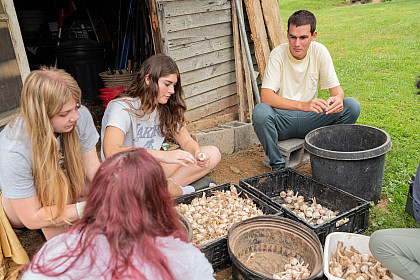 At the beginning of each academic year, all first-year students participate in a day-long Service Plunge.
 -
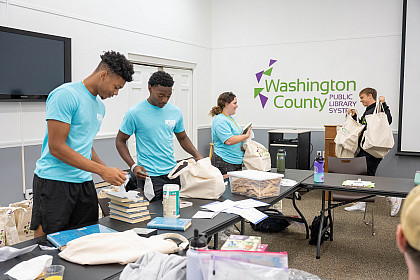 At the beginning of each academic year, all first-year students participate in a day-long Service Plunge.
 -
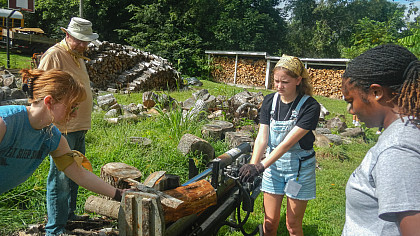 At the beginning of each academic year, all first-year students participate in a day-long Service Plunge.
 -
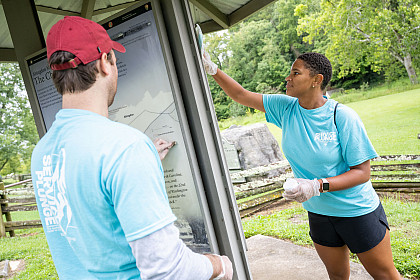 At the beginning of each academic year, all first-year students participate in a day-long Service Plunge.
 -
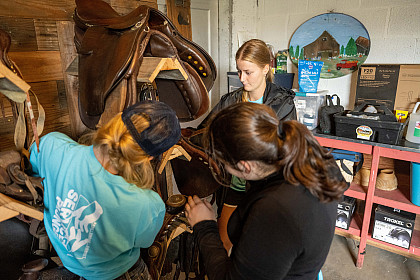 At the beginning of each academic year, all first-year students participate in a day-long Service Plunge.
 -
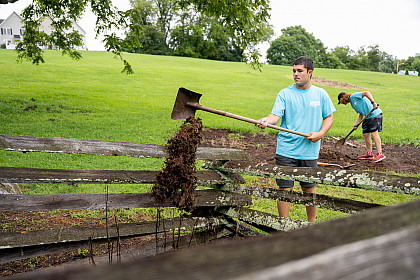 At the beginning of each academic year, all first-year students participate in a day-long Service Plunge.


Service Projects
The Appalachian Center for Civic Life directs numerous service projects that connect students with the community beyond Emory & Henry as well as the people who live, study or work at the University. Many of these projects originate in classrooms and involve community work that enhances the application of knowledge. Other projects may start with a campus organization and align with the service intentions of those student groups.
At the beginning of each academic year, all first-year students participate in a day-long Service Plunge, which acquaints them to the mission of the institution and to many important community partners who share the University’s dedication to improving life in Southwest Virginia and Central Appalachia. On campus, students support each other by managing two programs that help students with their day-to-day expenses: a campus thrift store and a low-cost food resource, The Stinger’s Supply Shelf.
Bonner Scholars

The program, however, is about more than volunteer hours. Students are involved in long-term civic engagement projects that result in tangible outcomes for the community while connecting their classroom experience with real world questions and issues. In this way, Bonner Scholars play a key role in the historic mission of the University to connect learning with civic responsibility.
Civic Scholarship
The Appalachian Center serves as the home for course work in civic innovation, which teaches the methods for the application of knowledge to problem solving in communities. Students of civic innovation discover an education that may support aspirations in public administration, non-profit leadership, business and education, to name just a few fields. In the meantime, students may find financial support for their on-going civic engagement through the Civic Leader Scholars Program, which provides a renewable, four-year scholarship for incoming first-year and transfer undergraduate students.
History and Literature
The Dan Leidig Appalachian Writer Series
The Emory & Henry Daniel Leidig Appalachian Writer Series (formerly Appalachian Literary Festival) celebrates the many forms of Appalachian narratives, including fiction, creative non-fiction, poetry, memoir, digital storytelling, and the creative arts. The Series offers a student-centered, publicly accessible opportunity to celebrate the work of a particular artist or artists, and to teach from and about narratives rooted in Appalachia.
The Watershed Project
The Watershed Project includes a wide range of voices and ideas that help to build a more expansive civic memory and a more viable future, one rooted in democratic civic practices that improve the quality of life for all persons in Southwest Virginia. Understanding that many approaches and many voices are required to tell the truths of a place and its people, The Watershed Project uses photographs, interactive maps, diagrams, oral histories, original documents, and videos to tell honest stories of Southwest Virginia. Challenging long-held perceptions and expanding what we know of our histories, The Watershed Project also tells new stories and offers new possibilities for our future in Southwest Virginia.
The Appalachian Oral History Project
The Appalachian Oral History Project (AOHP) began in 1973 and developed through a consortium involving Emory & Henry College, Appalachian State University, Alice Lloyd College, and Lees Junior College, now known as Hazard County Community College. Over the course of many years, students, faculty, and community members conducted and recorded personal interviews with thousands of citizens across the region. The Appalachian Center for Civic Life has digitized Emory & Henry’s portion of the oral history collection protecting the integrity and usability of the interviews in perpetuity. This digital collection is fully accessible and searchable. This remarkable resource is used in classes across the Emory & Henry curriculum, a resource for local communities seeking to better understand their stories, and is available to teaching and learning in any place.
Community Partners
Partnerships are vital to the service work to which our students are devoted. These partnerships provide the connections to a greater understanding of community challenges as well as to the means with which to meet those challenges. Students engage with community partners in efforts to eliminate food deserts, address substance use disorder, enhance small-business development and provide affordable housing, to name just a few of the areas of community participation. Students often report on their work with these partners to regional and national conferences, offering roadmaps for others to follow in solving problems in other communities. Among the many partnerships that engage students are People Incorporated, a non-profit community action agency devoted to improving lives and communities; the Appalachian Substance Abuse Coalition, which works to end substance use disorder; Feeding Southwest Virginia, which is focused on ending food insecurity.
Communications Outreach
